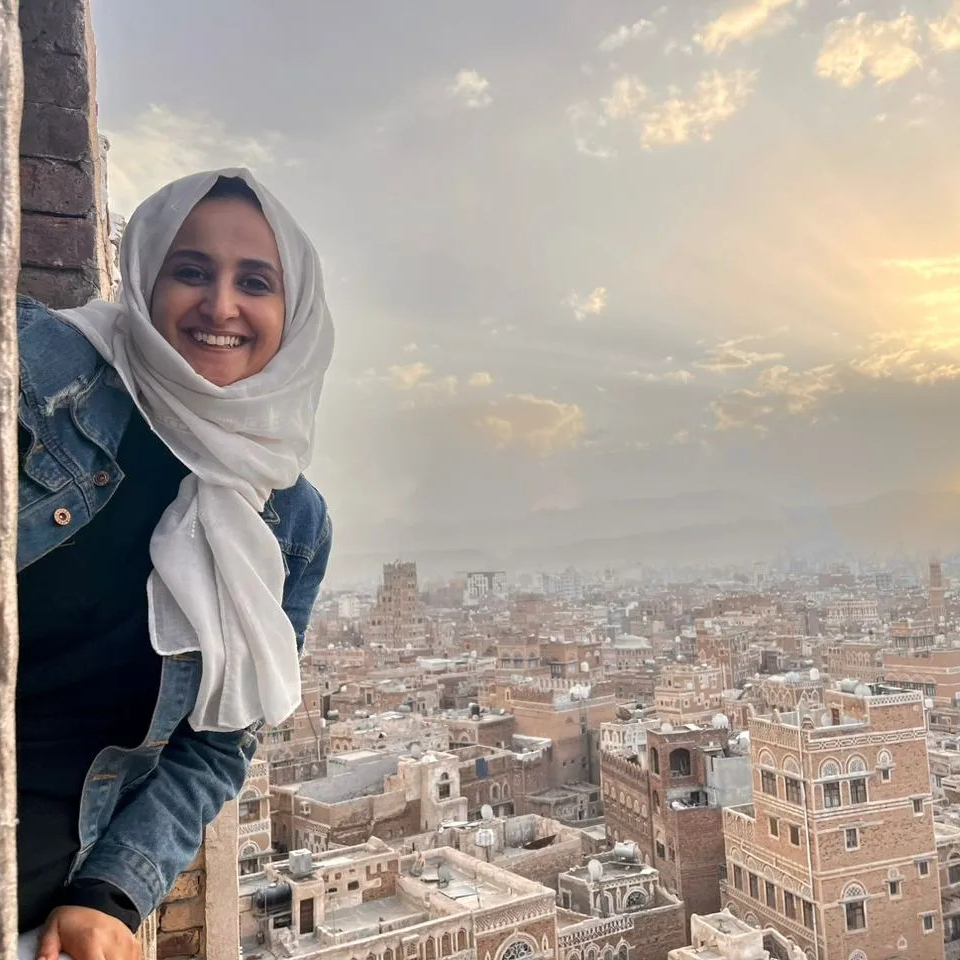
Nuha
Yemen, a nation once known for its rich cultural heritage and breathtaking landscapes, has been plunged into a state of unrelenting turmoil since its civil war erupted. It’s considered a conflict of complex and chaotic nature, taking place between multiple parties such as the Hadi government and its allies, the Saudi-led coalition, and Saleh loyalists. The conflict, now stretching into its ninth year, has ravaged this vibrant land, leaving behind cities and towns that bear the scars of relentless battles.
While this humanitarian crisis is as acute as ever and doesn’t show any promising signs of fading, it seems to have fallen into oblivion by most Western media outlets. Amnesty International even refers to this as the “forgotten war.” Nonetheless, the absence of sustained media attention does not diminish the urgency of drawing attention to the Yemeni people.
Intrigued to learn more about life in Yemen after eight consecutive years of war, I talked to Nuha, a human rights defender living in Yemen’s capital city Sanaa. Nuha is a 32 year-young woman who has been living in Sanaa all her life. Despite the ongoing conflict, which has forced nearly 4.5 million people to flee the country, not once did she consider the option of leaving her home.
“Yemen is my country. Sanaa is my city. It’s as simple as that.”
As a person looking in from the outside, I expected her to tell me about her exhaustion and about the hardships of life during such a prolonged period of conflict. However, to my surprise, Nuha’s positive mindset and heart filled with love for her country intrigued me to learn more about her story of Yemen.
Yemen is a country which is located in the southwestern corner of the Arabian Peninsula and is known for its uniquely diverse character. Split into twenty-two governorates, Yemen is home to people from a variety of ethnicities, languages, and religions. It’s a country in which ancient customs merge with modern aspirations. While each one of the governorates has its own persona and traditions, “Sanaa feels like a melting pot of Yemeni culture.” Nuha passionately explains that this is the reason why she admires her life in this city.
For Nuha, Sanaa is a perfect example of embracing Yemen’s cultural heritage while navigating the challenges of the present day.
For just over three years, Nuha has been working as a human rights defender. A career that might seem like a risky paradox, yet one that is quintessential given Yemen’s context. Especially during times of war where boundaries are being tested, and lines of accountability become blurry. Nuha acknowledges that by herself, she cannot dissolve the war. But this job gives her the feeling that she can at least make a small contribution toward a more peaceful country. Since her responsibilities include providing legal support to detainees as well as recording disappearances and torture, I assumed that Nuha must be terrified of going to work every day. But Nuha didn’t see it that way. “Yes, being a human rights defender can be dangerous from time to time. But in today’s version of Yemen, it isn’t more dangerous than any other job.” She is humbled by the ongoing conflict yet chooses to see everything in perspective, given that it is her decisive choice to stay.
While I was astounded by her courageous personality, I wanted to better understand this ongoing humanitarian crisis from the perspective of a person living in it. “If your country faces a humanitarian crisis, it doesn’t necessarily mean that every time you leave your house, you fear being shot. Yes, this scare comes up quite regularly, but it’s more so the small day-to-day challenges that really hit Yemenis. Most people lack basic necessities for reasons such as not receiving their deserved monthly salary; Instances like this can leave families without food for days. Another example is that it typically takes hours of waiting in line to get gas for one’s car, which isn’t safe in this context of war, nor is it helpful for people who have to get to work quickly and risk losing their jobs.”
Even though she is humbled and saddened by Yemen’s ongoing situation, she quickly jumped back to her statement about seeing everything in perspective.
Nuha recalled that since the war started, she had no alternative but to lower her standards. Nevertheless, this is something she decided that she would have to come to terms with if she wanted to continue living in the place she loves. Instead of worrying about the many ways in which her life has been restricted, she now focuses on celebrating the little things that she is still able to do. For example, going on small excursions around Sanaa or trying the different traditional foods from Yemen’s twenty-two governorates. But there is one thing in particular that uplifts Nuha every day. Namely, volunteering. Since 2011, she has been part of a local initiative that recycles clothes and distributes them to families in need. Members of this initiative, boys and girls, prepare the clothes to be ready for redistribution. Together, they collect the used clothes, wash them, cover them in a hint of perfume, and then give them away. In the beginning, this initiative started off with only 100 members but has been growing to include as many as 3,000 by now. Working together on a project with people from around Yemen makes her feel like they can all get through Yemen’s difficult situation together.
Despite the fact that Nuha keeps her chin up and tries to see the positive in this war-torn country, she’s realistic about the fact that life in Yemen is tough and people face severe humanitarian challenges. Because underneath her strength and positivity, she also feels a sense of exhaustion. “I’m not saying that we Yemeni people lived in heaven before the war. But we didn’t live in hell like we do now.” But the love she has for her country keeps, and her appreciation for the little things keeps her going.
“The war should be ended. Not my life in Yemen.”

 discoveredvoices.blog