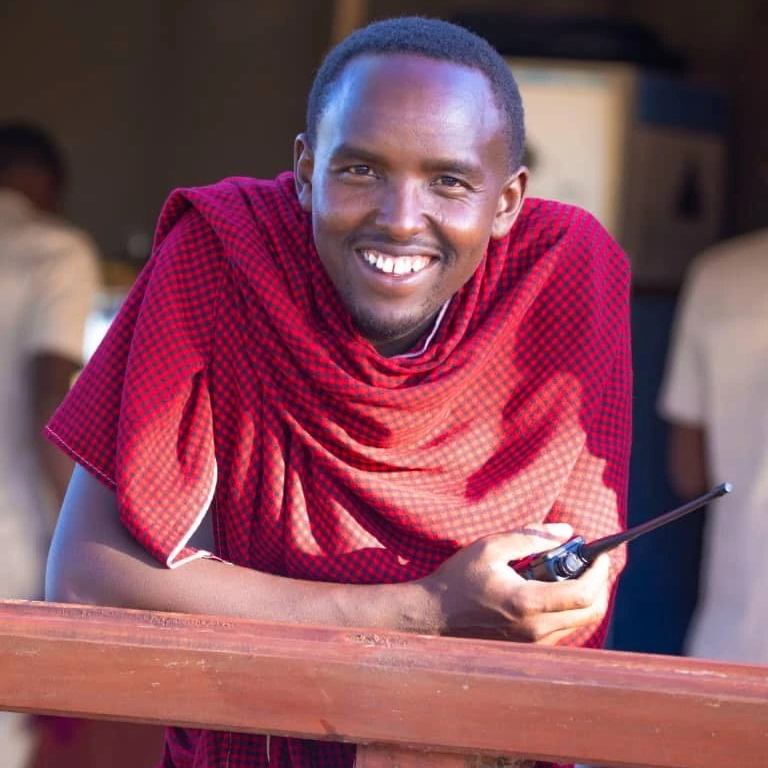
Moses
In Tanzania, there exist more than 120 different tribes. One of them is the Maasai tribe.
The Maasai tribe is a semi-nomadic pastoralist community that resides primarily in the East African countries of Kenya and Tanzania. You will identify their settlements as small villages, officially referred to as manyattas, which are placed in a circle and are made of mud, grass, and cow dung. Something that is very sacred and important to the Maasai is their livestock, which includes cows, goats, and sheep. They especially rely on their cattle for food, clothing, and wealth. As a matter of course, those who hold plenty of cattle are considered higher up on the hierarchy in their community. Something that continues to hold up the Maasai’s traditions is their unique history of standing up for themselves against British rule by not accepting the so-called new ways of life. Still today, most elderly members of the Maasai communities do not understand nor accept it when members of their tribe want to obtain an education- as this is something that the British introduced. But, in today’s increasingly modernizing world, many of those historical traits are difficult to continue pursuing.
Now, many young Maasai generations try to find a balanced life that includes Maasai traditions while adapting to the modernizing world. But this is not always easy.
While making my way driving through northern Tanzania, I couldn’t help but notice these above-mentioned small villages and the distinctively dressed people living within them- wearing colorful robes and beaded jewelry.
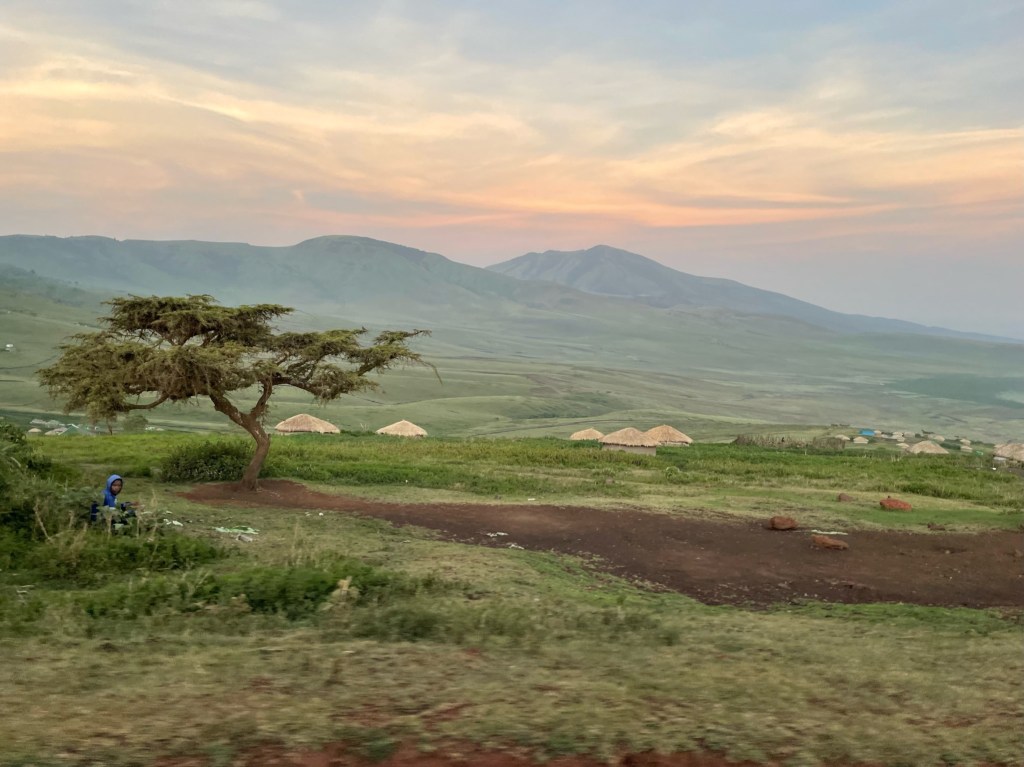
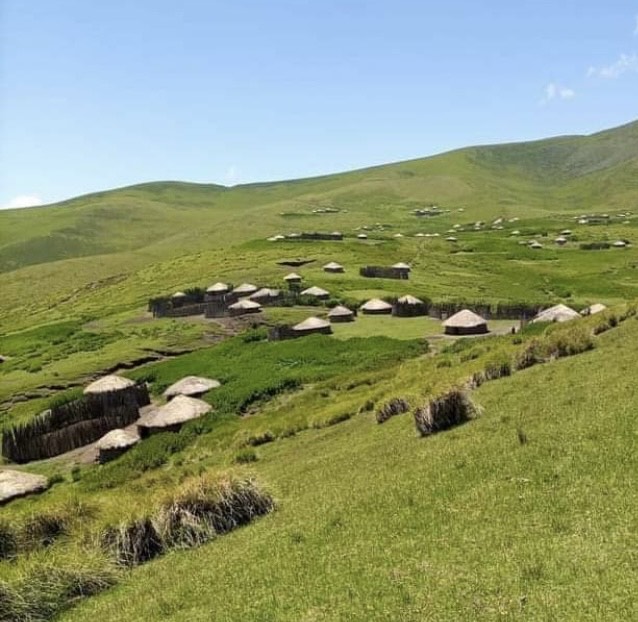
It is commonly known that many Maasai communities reside close to game drive areas, which explains the villages that I encountered on my way to the Ngorongoro Conservation area. While setting up our tent at a campsite close to the edge of the Ngorongoro Crater, a young man called Moses came up to me and offered a hand in setting up the tent. In our conversation, he mentioned having grown up in a Maasai community within the Ngorongoro Conservation area. Intrigued to learn more about being a Maasai in a modernizing world, he told me about his personal experiences and struggles.
Moses is a young man in his twenties who was born and raised in the Maasai’s traditional way of life. He is the third-born to a polygamous family in which his father has four wives and more than 20 children. While having a dad who has more than one wife might seem rather unconventional to us, it is something that continues to be rather common in Maasai communities. Moses explained that most of the small villages one might see while driving through Tanzania are likely to be very large families like his.
Then, Moses started thinking back to his upbringing and how his young assertiveness has led to his rather “modern” approach to the Maasai lifestyle that he is living now. Already as a young boy, just as Moses mastered how to walk, he started herding cattle. While staying close to his community’s settlement, he took cows and goats to places where they could grass. This was a lot of responsibility for such a young boy who barely knew how to walk. Yet, this was one of the common practices of a Maasai upbringing.
Then, at the age of eight, he started going to primary school. This is something that former Maasai generations were not allowed to do, as obtaining an education was considered one of the so-called “new ways of life” that were introduced by the British. Even though he was now allowed to go to school, after numerous intense and long discussions, going to school was not easy. Given that is village was located in a remote area in the middle of the conservation area, he had to walk more than 15 kilometers to reach the nearest school. But the distance was not the only challenge the young Moses had to face. Living in a conservation area also means that wild animals are walking around freely. On his daily way to school, it was not untypical for him to encounter wild animals like lions, elephants, and buffalos. Animals that most tourists are only allowed to see from a car parked at a safe distance.
Despite all obstacles, Moses has been well underway toward becoming independent while continuing to honor the Maasai traditions. Because after successfully graduating from ordinary-level secondary school and advanced-level secondary school, he was recently able to graduate from university with a degree in economics.
However, Moses explains that even with a university degree, being a Maasai in this modern world is not easy. Nowadays, there are many challenges that the Maasai face, which can no longer be solved in the way they were solved in the past. Since his family made an exception by allowing him to go to school, they now have very high expectations for him. So, Moses has been working hard and has dedicated all his efforts toward his dream:
“After graduation from university, I had a big dream and desire to one day be economically independent and powerful. I want to earn enough to be able to sustain myself while also supporting my family, who has been financially struggling in this modern world. ”
Unfortunately, Tanzania’s currently high unemployment rates make it nearly impossible for Moses to find a job in the field of his study. Instead, he now works in the tourism sector for the conservation area in which he has grown up. This also explained our encounter at the campsite of the Ngorongoro Crater. While his salary is currently not enough to fulfill his dream of financial independence and supporting his family, But, like the distance he used to travel to school, this is something that doesn’t make him give up on his future dreams.
Even though Moses now follows a rather unconventional path in life in the eye of the Maasai tribe’s traditions, he appreciatively looks back to some of the typical Maasai traditions that made him a true man who holds important values. He explained that there are certain very specific stages that a boy has to pass through in order to be recognized as a true Maasai man. Specifically, from the age of four until 14, a young Maasai boy is called “alayoni”, and one’s main roles include herding cattle and goats as well as supporting one’s mother in the process of milking the cattle. By being given the responsibility for the livestock, the young boys are being taught the importance of accountability for themselves and their community. The second stage is then called “morani”, which stands for warriors and lasts until the age of 35. Moranis’ responsibilities are to protect their community and cattle against intruders and wild animals. This is mainly done by using a spear. But apart from such physical responsibilities, the morani are also taught the importance of showing respect, love, courage, and wisdom toward everyone they meet. After passing through this warrior phase, one is finally considered an elder and is not allowed to use a spear anymore. From that moment onwards, one must use one’s wisdom.
These values, respect, love, courage, and wisdom have been passed on from generation to generation and are the glue that keeps the Maasai community together.
By stepping outside the traditional path of a Maasai man, Moses hopes to achieve two things. The first thing is, as mentioned above, achieving economic independence and being able to support his community financially. But the financial aspect is not the only motivation since many Maasai elders remain critical about their members partaking in modern life. Through his educational background, Moses also aims to set an example to his community, especially children and the generations to come, that it’s time to extract the benefits from the modernizing world. He wants to showcase that it is possible, and even desirable, to combine both worlds- living by honorable Maasai traditions while also being educated and financially stable.

 discoveredvoices.blog