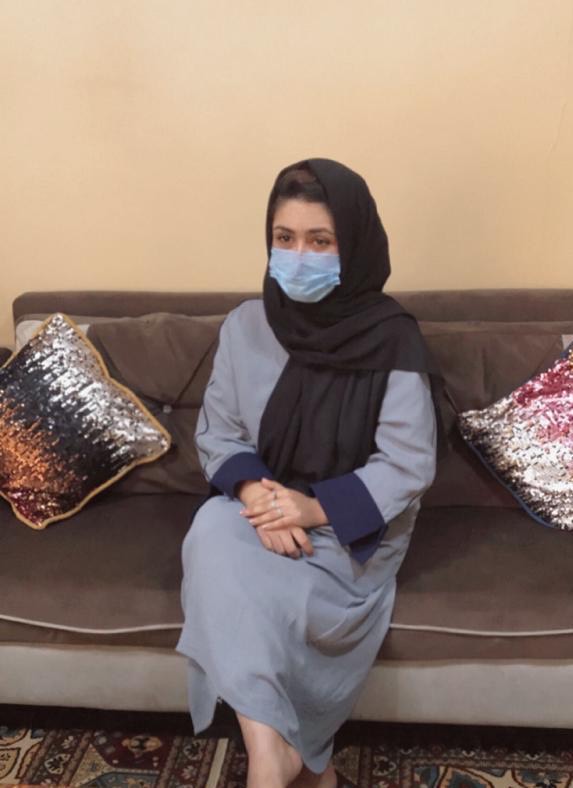
Komal
Komal is the second oldest in her family’s sister constellation of five. The 23-year-old considers herself as fortunate that she was able to complete her university degree just before the Taliban banned all Afghan girls from continuing their education past the primary school level. Seeing her three younger sisters struggle to pursue their dreams makes her determined to stand up for girls’ and women’s rights in the country she loves and calls her home.
The Taliban is a fundamentalist Islamic militant group that originated in Afghanistan in the early 1990s. Towards the end of the 20th century, they were able to gain control over most of the country and were mostly known for their immensely strict interpretation of Islamic law and their restrictive treatment of religious and ethnic minorities as well as women. One of their harshly enforced rules that had captivated the Western media’s attention was the one that forbade girls from attending school and not allowing women to work outside their home. Women were not even allowed to leave their houses without a male representative. However, in 2001 the group was deprived of its power by US and NATO forces and was only able to regain its control over Afghanistan recently in 2021. While some progress was made in the years following the Taliban’s defeat, including the reopening of schools and women’s participation in politics and the workforce, girls, and women now continue to face significant challenges all over again. For many Afghans, especially the outspoken ones, staying in the country is not an option, and have no choice but to flee the country. As a result, the United Nations estimates that about 3.5 million people have now either been displaced internally or across borders to countries like Pakistan, Iran, Turkey, India, and Germany.
“It’s heartbreaking to see your friends leaving the country”, Komal reveals. “Nobody chooses to leave their home voluntarily. But sometimes, there doesn’t seem to be any other option if you want to live a peaceful life with basic human rights.”
Despite the countless hardships that women in Afghanistan have had to endure, many Afghan women have shown incredible strength and resilience in fighting for their rights. Some- among whom Komal- decide to hold on to hope for a better future and believe that they can be part of creating positive change for their country.
While staying in Afghanistan shows great resilience, it can by no means be considered as easy. For example, after the Taliban regained control in 2021, Komal couldn’t leave her home for six full months. For her, being an independent, goal-oriented, and hopeful woman, this time felt utterly despairing. A feeling of gloominess and misery started flooding her body.
Yet, after this timely and frustrating period, Komal told herself: “If you continue to feel depressed and lock yourself up, you will achieve exactly what the Taliban intended for- controlling women. But if you accept the current reality and find a way to work with it, then you are in a position to strive for change.” At this moment, Komal realized that change doesn’t happen by doing nothing, so she decided to get back up and move forward.
Komal and her family and friends learned that you must take the situation one day at a time. “You have to make the best of the rights you have today and strive for the rights you can have tomorrow.”
Komal enthusiastically exclaimed that she just accepted an offer to her dream job. Her family is in full support, celebrating Komal’s rights of today while striving for her sisters’ rights of tomorrow. Even Komal’s best friend, Aisha, lives by this principle. She used to work for an NGO which provides education to girls in Afghanistan. When the Taliban banned women from working for NGOs, her friend didn’t give up. Instead, Aisha works hard every day to find ways and loopholes to bring education to girls in Afghanistan, even if it’s through online classes.
The meaning behind the name Komal is tender, gentle, and sweet. Even though her character shows high levels of assertiveness, her unique way of approaching the Taliban’s takeover is a true illustration of the meaning behind her name.
“I decided to accept the Taliban. This doesn’t mean that I agree with their actions, but it means that I have come to terms with their presence and hope for a future in which we can come to a collaborative solution in which girls and women are given back their freedom.” While there are diverging projections regarding the future of Afghanistan (some believe that there is no way out while others believe that it requires a physical war), Komal’s hope lies in what many would call ideological and wishful thinking. She isn’t looking for a physical fight with the Taliban. Instead, she fearlessly and desperately hopes for a peaceful conversation. She wants to try to understand the Taliban’s rationale behind depriving women of their fundamental rights, especially given that the Taliban has previously promised not to take them away.
When Komal tells people about her belief that a peaceful approach would be the most sustainable and long-term solution for Afghanistan, people usually start laughing at her wishful thinking. “You’re too ideological. Just have a look at the world. Why is so much war happening if a simple talk could be the solution?” But like historian Rutger Bregman, Komal tries to redefine what the realist position can be. Instead of physical war, Komal continues to believe in the power of dialogue and hopes that the world can reach a point where wars can be resolved through conversation.
Komal acknowledges that taking women’s rights away is a power move and understands that having a dialogue with the Taliban might not change the entire situation. But she remains sanguine.
Komal’s open-minded demeanor makes her less frightened when she leaves her house and finds members of the Taliban guarding the streets. She explains, “What we have to understand is that we cannot put all of Taliban’s members into one box. Sometimes, I talk to the guards on the road that my family lives on. Many of them also have wives and daughters. They don’t want them to suffer either. It’s mainly the head of the Taliban who captivates this mindset of depriving women of their rights.”
Despite all the hardships and vulnerabilities Afghan women continue to face, Komal is determined to stay in Afghanistan.
“I don’t want to speak for all Afghan girls, but for me, my soul tells me that staying in Afghanistan is the only right choice. The women 30 years ago were strong fighters, and I want to continue that fight. I want to fight for my rights, my sisters’ rights, and all other Afghan girls’ rights. For me, leaving the country is not an option.”
*Please note that some minor details have been adapted for the reasons of security.

 discoveredvoices.blog