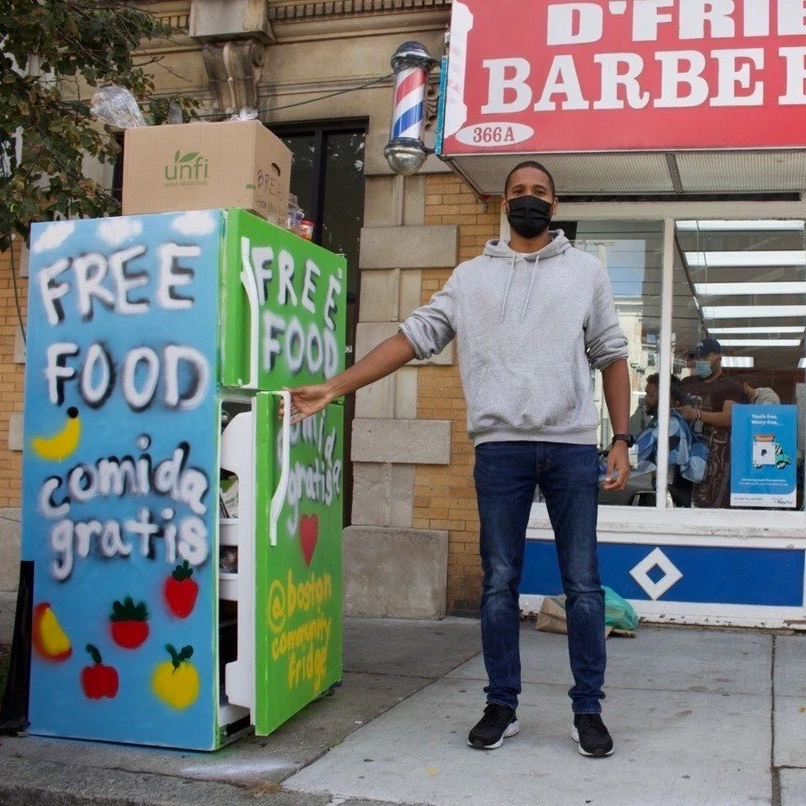
Josiel
“Take what you need. Leave what you can.” Through the community fridge project in Boston, Josiel wants to normalize the act of giving as well as the act of receiving.
While Boston was battling to withstand the turbulent period of surging Covid cases, rising unemployment rates, and widespread helplessness, Josiel decided to introduce a project to his city that would not only support his fellow community members in these unprecedented times but would also contribute to decreasing food waste of local supermarkets, bakeries, and farms.
Amid the Covid crisis in July 2020, Josiel stumbled across a newspaper article about a unique activity that was taking place in New York. Namely, setting up public fridges outside of supermarkets and apartment complexes- areas that were easily accessible. And yes, you heard correctly. Fridges that you typically see in people’s kitchens can now also be found outside on sidewalks. Almost immediately, Josiel realized that this kind of project would not only be beneficial for New Yorkers but also for the city’s neighbor, Boston. Inspired by the project Josiel had just learned about, he decided to share his idea of bringing the fridge project to Boston, online. Turns out, coincidentally, another person simultaneously had the exact same thought. Naturally, Josiel and his fellow Bostonian, Veronica, decided to join forces and continued to spread their plan online.
“It’s so innovative, yet simple at the same time. I mean, have you ever gone on an outdoor walk and stumbled across a fridge? Pantries sure, but fridges certainly no [laughs].”
In no time, people from across the city were intrigued by this unusual yet clever project and decided to join the movement. The group of supporters rapidly grew and diversified. There were people from all different areas throughout Boston. That’s when the decision was made, to split up into smaller groups, each dedicated to a specific area in Boston. This way, the project could be implemented in different locations and could be individualized according to each community’s identity and needs.
The first thing that was on each team’s to-do list was to acquire a fridge and to find a host. “You have to be strategic about where to place the fridge. You can’t just put it in the middle of a sidewalk.” For one, the fridge must be easily accessible for the community members. The project will not be as impactful if people have to spend a long time on searching for the fridge. The purpose is to mainstream and simplify giving and receiving, which can only be achieved if people don’t have to go out of their way too much. Also, you need someone who is willing to host it. There are usually stores or restaurants along the sidewalk, who you have to ask permission from to use their space. And not to forget, you need to plug in the fridge for electricity, otherwise the food goes bad.
Josiel found himself on the JP team, which is short for Boston’s Jamaica Plain neighborhood. While brainstorming about the to-do list, one of his friends suggested that Josiel should pitch the project idea to D’Friends Barbershop. His friend knew the enthusiastic owner and thought it would be certainly worth a shot to ask if he’d be interested to be involved in this project. Josiel loved the idea and agreed to give the barbershop a try. Not only because of the pitch, but also because he was in urgent need of a haircut.
A couple of days later, Josiel walked over to the barber shop. While he was getting a fresh haircut, he pitched his idea of bringing the community fridge to JP Boston. The barber loved the idea and without hesitation offered to host the fridge and to cover its electricity costs.
When Josiel’s mother offered to donate the fridge, the project was ready to start. As the first group to actually realize this project in Boston, the JP team immediately got a lot of attention and recognition. On their Instagram account, they made a call to action. Anyone who has the resources to donate food or beverages to the fridge was invited to do so. And people who couldn’t afford enough for themselves or their family was invited to grab it from the fridge. There is no oversight mechanism whatsoever. It’s all based on empathy and trust.
Because this project got introduced to the Boston area during the Covid pandemic, it was strongly appreciated by the many community members that were financially struggling every day to get enough food to the table. Josiel was grateful and fascinated to see how a project like this could unite a community in all different kinds of ways.
For instance, there are volunteers that take pictures of the fridge three times a day in order to share it on the project’s Instagram page. This way, community members knew how the fridge was currently stocked and what might still be needed. During the hot summer days in 2022, this was especially helpful because this method allowed people to see whether the fridge was sufficiently stocked with water, or whether it needed some more.
When I asked Josiel if it might sometimes be the case that people feel uncomfortable taking food out of the fridge, given that this might signal something to the community regarding this person’s financial situation, he immediately agreed how this could be an issue. “One time, I was just hanging out next to the fridge, as I quite regularly do. A woman from the apartment complex nearby wanted to take something out of the fridge but hesitated when she saw me sitting there. Her facial expression gave away that she felt guilty and immediately searched for an excuse. She told me that she used to be financially stable, but since the Covid pandemic her and her husband weren’t able to pay their rent on time anymore and now faced eviction. I expressed my sympathies and explained that even though I empathize with her situation, she doesn’t have to explain or justify herself. The motto of the fridge is ’take what you need and leave what you can’, that’s what the fridge is for.”
By hanging out next to the fridge, Josiel learns a lot about his community members that he previously didn’t even know. Humbled by the scope this project has reached, he adds that “even if this project would have only reached one household that was struggling, it would have already served its purpose.”
Indeed, this project shows that doing something good can be rather simple. It does not require large donations nor a huge time commitment. If someone has the means to purchase an extra bottle of milk on their weekly grocery trip and put it into the fridge, it can already make someone very happy.
Now, two years later, while the project is still up and running throughout Boston, Josiel reflects on the impact this project has had. “It’s quite inspiring and hopeful to see how a community can bond over a project like this.” But the impact of this project goes even further. For one, it encourages less food waste since stores and restaurants can stock the fridge with their leftovers that would otherwise have had to been thrown away. Also, most people who typically can’t afford, tend to choose for cheap and unhealthy options like McDonalds or KFC. In countries like the United States, a $1.99 cheeseburger is oftentimes cheaper than a couple of peppers that wouldn’t even satiate you. Through the introduction of a public fridge, it invites people to donate healthy and nutritious foods as the fridge keeps it fresh. This way, this project helps to break the viscous cycle of unhealthy eating if one’s resources are limited.
So, when you walk by a fridge on the sidewalk, don’t be surprised. It has quite a unique backstory.

 discoveredvoices.blog