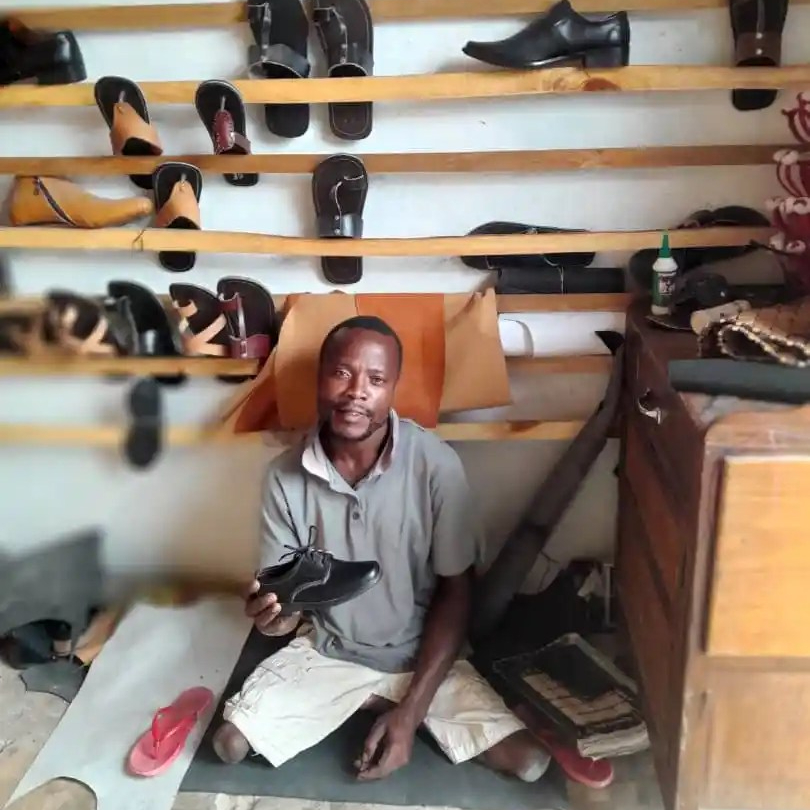
Richard
“I was the only person with a disability in my hometown. People were not used to seeing someone looking different from themselves. All the dreams that I once had, were suddenly taken away from me. But I told myself that I had a choice. I could do nothing and just feel sorry for myself. Or I could stay positive, work hard, and find new dreams to fight for.”
Richard grew up in a rural town isolated from Tanzania’s populous city of Mwanza. Like most families in the rural areas of Tanzania, his parents were struggling every day to bring enough food to the table to feed the family of five.
For Richard and his two siblings, nonessential requests were not open for discussion.
The family’s situation started becoming even more difficult when Richard started feeling ill. For months on end, doctors’ visits became a regular order. At that time, he was only ten years old, but the hospital already started feeling like an unavoidable second home.
Richard felt like a burden. His parents were barely earning enough to get the family through the day. He could only imagine what they had put themselves through to allow him the care he needed.
His situation was getting worse by the day. At the beginning, he was feeling feverish and nauseous. “Malaria pills should help”, the doctors said.
In many African countries like Tanzania, hospitals don’t have enough resources available to invest in research. Most diseases that fall outside the scope of what is known, remain untreated. This was also the case with Richard. Malaria is one of the most common diseases in the country. Richard’s doctors made a educated, yet helpless guess about providing him Malaria pills. Unfortunately, Richard the pills did not work because Richard did not have Malaria.
After one year of continued unsuccessful doctor’s visits, Richard’s parents started feeling a sense of hopelessness and desperation. They couldn’t see the light at the end of the tunnel.
But Richard didn’t want to give up.
Suddenly, Richard started experiencing hefty aching in his legs. A system that is not known to be common in Malaria patients. The doctors realized that waiting was not an option anymore. Without knowing the root cause of his pain, they unanimously decided to amputate both of his legs. “I don’t know if they made the right choice” Richard said, ‘but all I know is that we wouldn’t have been able to figure out this disease anyways. By amputating my legs, I was at least able to continue living. Who knows what would have happened if they didn’t act so quickly,”
Up until that point, the world seemed endless to Richard. “I had big dreams for my future. I wanted to study and hoped to successfully complete secondary school” he recalled while looking out of the window. But this dream was no longer feasible. When the doctors amputated both of his legs, many people from his town started looking at him differently. Even his parents didn’t know how to react and told him that he could no longer go to school.
He felt hopeless and lost, asking himself “why me?”
Richard was brought up knowing that anything that was not food is not considered an essential request. Therefore, he already knew that buying a wheelchair was not open for discussion in his family.
So, Richard spent most of the days inside. Only once in a while, he would go outside to get some fresh air. On these occasional days, he would aimlessly crawl up and down the small path in front of their house. One day, a family stopped along the path when they saw Richard. It was a warmhearted family that immediately offered to purchase a wheelchair for him.
From that moment forward, the world seemed a little bit more hopeful again.
He remembered that that he is still alive. The only thing that has changed is that he has two less legs than before. He still has functioning hands and arms. Most importantly, his heart is still beating. So instead of being sad about not being able to live the life he envisioned as a kid, he decided to look for new dreams to follow. Not everyone has the chance to do that.
Soon after the day that he met that considerate family, he decided to start over. He moved to a larger town near Mwanza, where his physical impairment did not determine people’s view of him.
Without a plan, yet determined to be independent, Richard did not want to be too harsh on himself. He took it one step at a time.
To start earning some money, he grabbed a stool, placed it alongside the town’s main road, and started cleaning the shoes of people passing by.
He continued this for a while until one of his regular customers told him about an organization that offers free shoe-making classes to people that have a disability.
“At first, I was very stubborn and did not want to take on that offer. I didn’t want to get free education out of pity. But after some contemplation, I came to the conclusion that I should be extremely grateful that such offers exist. Many employees won’t hire someone with a disability. So, such offers give us the chance to be hopeful again!”
And like that, Richard found a new dream to fight for. Becoming a shoemaker.
Now, a few years later, Richard is very well-known for his shoemaking skills. People from all around Mwanza come to buy shoes at his very own store. He makes beautiful hand-made leather shoes. But that’s not all. Richard dedicates all his free time to advocate for the rights of people with a disability in Tanzania.
He is especially dedicated to reaching young people who also live with a disability. “I experienced it myself; it is difficult to see other kids playing around while you sit there and watch them. But it’s important to stay positive. Embrace the unique abilities that you have. And more importantly, stay strong for yourself and find dreams to fight for.”
At the end of our conversation, Richard looked at me with a big, proud smile full of intent. “Please tell your friends that, if they ever visit Tanzania, they are more than welcome to stop by and shop at my store.”

 discoveredvoices.blog