Sarah
In the contemporary world, there is a lot of dialogue and debate taking place about the concept of ethnicity, race, gender, sexual orientation, and socioeconomic class. There exist numerous divergent opinions on how to create a ‘better’ world.
But what even is a ‘better’ world? And who defines what this world should look like?
Surely, many people would agree that a better world would be based on increased awareness, inclusion, equality, and equity. A world without assumed inferiority or superiority. At least, that is what public discourse predominantly refers to. However, it is also fair to say that there exists not one ultimate way of reaching this goal.
Sarah, a woman with an encouraging view of the generations to come, discovered her own unique way of taking a step towards this goal. She has been living in the Dominican Republic for quite a few years and now runs a school where she teaches young kids the importance of ‘coming close to one’s differences.’ In her experience, the idea of coming close to one’s differences at a young age teaches future generations that there is no “us” and “them.”
In 1997, Sarah moved to the Dominican Republic for the first time. She was a college student with an aspiration to improve her Spanish knowledge. “Being a young woman in a foreign country at times can be frightening,” she says. “If you don’t make a little bit of effort to learn the local rules and norms, you can feel left out and lonely.” Sarah soon knew that she didn’t want to be in a different country and feel like a complete outsider. So, she decided to put all her efforts into learning as much Spanish as possible as well as getting to know the customs of the Dominican Republic.
Following this time of having been part of the local community, Sarah kept gravitating back to the people, culture, and local traditions. To no surprise, Sarah decided to move back permanently to the Dominican Republic in 2004. She settled in the small town of Cabarete, where, soon enough, she would bring about change in a community where people would come close to their differences.
Cabarete is undeniably an attractive destination for many expats. It lies on the North coast of the Dominican Republic, where there are waves for surfers and kiters, and mountains in close proximity for nature lovers. However, what many people overlook who come to the town from abroad is the fact that most local people live in poverty. About 30 per cent of the children in Cabarete are not able to complete primary school, and many families do not have access to water and clean, sanitary facilities.
While being aware of being a white, non-Dominican woman herself who comes from a privileged background, she was quite bothered by the divide between people in Cabarete based on socio-economic class. Most expats lived completely separate from the local communities, oftentimes in gated communities, while sending their kids to private schools that local families could never afford. “It was a visual of extreme inequalities.”
It’s not only that. Sarah also reflected back on her time when she was first in the Dominican Republic and felt like a complete outsider. “Nobody should live in a country and not at least try to be part of it,” she says. “It creates a world of us versus them, while we should all be one community that loves each no matter its differences”.
That’s when Sarah decided to address this issue that she faced in the town that she now calls home. She established 3 Mariposas Montessori (3MM), a nonprofit school. Of course, it sticks to the regular curriculum, yet it incorporates more elements of life learning. She chose to have a student body where sixty percent of the students come from families that live in poverty. The other forty percent of the students come from kids of expat families. It’s a student population that is composed of children from various cultures, nationalities, and socioeconomic backgrounds. Since Sarah was fully aware that most local families would not be able to afford the tuition, she established two payment methods. Parents that have the financial means to pay the tuition will do so. However, parents who do not have the means have the possibility to ‘pay with time’. This is a unique approach because this way, parents could be helping to cook lunch for the students or go fishing to provide lunch. This way, each family, no matter the socioeconomic background, has the opportunity to send their children to a quality school.
Sarah is extremely motivated. “I believe that schools, and any other institution or person for that matter, can learn that taking the time to learn about people different from oneself is the key to a more inclusive world.”
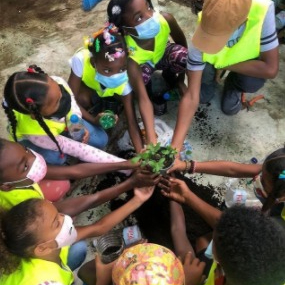
At 3 Mariposas Montessori, the kids get the chance to get close to each other’s differences simply by playing, exploring, eating, sharing, and learning together. This way, children and students get to know each other for who they really are instead of having been labeled someone based on their socioeconomic background. At such a young age, kids don’t even know the definition of socioeconomic background and learn not to use labels. At the same time, the parents see the way the kids interact with each other and are inclined to re-evaluate the understanding of differences that society has taught them.

 discoveredvoices.blog